Everything included in a RentalWebStudio website

Fourteen things, each one a job that currently belongs to somebody in your business. Below, every feature says what it does, the problem it solves for a rental fleet, what you have to do about it (almost always nothing), and which of the three plans carries it.

Pages that open instantly

Custom-coded pages served from the edge, built to hold a 90+ PageSpeed score.

The problem it solves
Renters plan trips on a phone with patchy signal, and a photo heavy fleet page that takes five seconds loses them before the first vehicle appears.
What you have to do
Nothing. Send the photography and we handle compression, formats and the performance budget on every page we add.

Why speed matters more for a fleet site

A slow page loses a renter before the fleet ever loads. Every page on your site is custom coded, ships almost no JavaScript, and is served from a global edge network, so a full page of vehicle photography opens as fast as a page of plain text. That matters most on the day a trip is being planned on a phone with patchy signal, which is exactly when most rental searches happen.

Built to hold the score, not just pass it once

A 90+ PageSpeed score on launch day means little if it drops the first time a new vehicle class is added. Images are compressed and served in modern formats automatically, fonts are loaded without blocking the page, and every new page we build follows the same performance budget as the first one, so the score holds as the fleet grows rather than sliding month over month.

Available on: Showroom, Concierge, Flagship

A dedicated page for every vehicle class

Luxury sedans, SUVs, campers, vans and event cars each get their own page and their own search visibility.

The problem it solves
One long vehicle list means a renter searching for a campervan and a renter searching for a wedding car land on the same page, and neither finds what they asked for.
What you have to do
Tell us your classes during onboarding. We build the pages and add new ones as a change request when the fleet grows.

One page per vehicle class, not one long list

A renter searching for a campervan and a renter searching for a wedding car are looking for two different things, so they land on two different pages. Each vehicle class gets its own page with its own photography, its own specification list and its own reservation call to action, which gives search engines a specific page to rank for a specific search rather than one page trying to rank for everything.

A specification block that reads like a fact sheet

Every class page carries a plain specification block: seats, doors, transmission type, luggage space and the terms that apply to that class. Renters compare classes on facts rather than adjectives, and the same block gives search engines a clean, structured piece of content to pull into an answer when someone asks what a specific vehicle class includes.

Available on: Showroom, Concierge, Flagship

A reservation request flow that qualifies real trips

Pickup date, return date, location and vehicle class collected up front, so the first reply is useful.

The problem it solves
A generic contact form leaves the dates, the pickup point and the vehicle class for a phone call, so every enquiry starts with a round of questions.
What you have to do
Tell us where requests should land. After that they arrive in your CRM already qualified.

The fields that actually matter to a rental enquiry

A generic contact form asks for a name and a message and leaves the actual trip details for a phone call. The reservation request flow asks for pickup date, return date, pickup location, vehicle class and any add on drivers or equipment up front, so whoever answers the enquiry can reply with availability and a rate range on the first message instead of a round of questions.

Every enquiry lands where your team already works

Completed requests are delivered straight into your CRM, inbox or booking system by direct API, Zapier or Make, whichever you already use. Nothing sits in a form plugin waiting to be checked, and nothing needs a new tool for your team to learn.

Available on: Showroom, Concierge, Flagship

A page for every pickup and drop off location

Airport counters, city depots and delivery zones each rank for their own local search.

The problem it solves
An airport counter and a downtown depot are two local businesses sharing one page, so neither ranks for the area it actually serves.
What you have to do
Give us the addresses, hours and the classes available at each. New counters are added as a change request.

Local pages for a fleet with more than one counter

A rental company with an airport counter and a downtown depot is really running two local businesses, and each one needs its own page to rank in its own local search results. Every location page carries its own address, hours, directions and the vehicle classes available from that counter, so a search for a pickup near a specific airport or neighborhood finds the right page rather than the home page.

Delivery and one way zones get their own page too

If the fleet delivers to a resort area or allows one way drop off in another city, that zone gets a page of its own describing the terms and the classes available for it. This is the same page architecture a national brand uses to rank in every market it serves, sized to fit a fleet with a handful of locations rather than hundreds.

Available on: Showroom, Concierge, Flagship

Daily, weekly and monthly rate pages

A rate structure page for every rental term, written in your own numbers, never invented ones.

The problem it solves
Mileage allowances, deposits and minimum hire periods live in your team's heads, so the same five answers get typed out for every enquiry.
What you have to do
Send us your rates and terms. We never publish a number you did not give us, and you update them whenever they change.

A clear page for how your rates actually work

Daily hire, weekly hire and monthly or long term hire are different products with different terms, and each gets its own page explaining mileage allowances, deposit handling and what changes at each length of trip. We build the page structure and the copy around the rates and terms you give us. We never publish a number we were not given, and every figure on the page is yours to update as your own rates change.

Seasonal availability without a guessing game

Where a fleet runs different availability or minimum hire periods in peak season, the rate page explains that plainly rather than leaving a renter to find out at the enquiry stage. This is written and structured content, not a live pricing engine, so it stays accurate to whatever your team tells us and updates the moment your terms change.

Available on: Showroom, Concierge, Flagship

Researched articles published every week

Original articles about the trips, routes and rental questions your renters are already searching.

The problem it solves
Nobody in a rental business has time to write, so the site is untouched since launch and there is nothing for search to find beyond the home page.
What you have to do
Review the topic list in your portal and flag anything to skip. After that they are researched, written and published on schedule.

Content that answers what renters actually search

Every plan includes researched articles published on a weekly schedule: two a week on the first two tiers and three a week on the top tier, each between 2,500 and 3,200 words. Topics come from real questions renters ask before a trip, such as what a rental deposit covers or what to check before a long weekend hire, always written in your fleet's own voice and never presented as legal, insurance or licensing advice.

Built to be found, not just published

Each article carries the same technical foundation as the rest of the site: a clear title, a meta description, a table of contents, cited sources for any figure mentioned and a set of on-page questions and answers matched to search intent. Articles are added to the sitemap and the site's AI-facing content feed automatically, so a new page starts working for search visibility the day it goes live.

Available on: Showroom, Concierge, Flagship

The AI Engine

A trained agent that answers fleet questions and qualifies reservation enquiries around the clock.

The problem it solves
Most rental enquiries arrive in the evening or at a weekend, when the trip is being planned and nobody is at the desk to answer.
What you have to do
Nothing. It is trained on your fleet during the build and updated whenever a class or a term changes.

A qualifying agent, not a generic chatbot

The AI Engine is trained on your fleet, your locations and your rate structure, so it can answer a real question about vehicle class availability or pickup locations rather than deflecting to a contact form. It collects pickup and return dates, location and vehicle class preference before handing a qualified enquiry to your team, and it is configured never to quote a rate, confirm a booking or give insurance or licensing advice.

Available after hours, handed off when it should be

Most rental enquiries happen outside business hours, when a trip is being planned in the evening or on a weekend. The AI Engine keeps the conversation moving until your team is back online, and it is built to recognize when a question needs a person, handing off cleanly rather than guessing.

Available on: Concierge, Flagship

The Content Engine

An expanded content operation for fleets that want to own more of the search results in their market.

The problem it solves
A fleet competing in a busy market builds topical coverage too slowly at two articles a week to catch the fleets already ranking.
What you have to do
Agree the quarterly topic plan. Everything after that is done for you.

Three researched articles a week instead of two

The Content Engine steps the article schedule up to three researched pieces a week, each 2,500 to 3,200 words, so a fleet competing in a busier market builds topical coverage faster. The extra volume is used to go deeper on the sub-niches and locations that matter most to your fleet rather than spreading thin across unrelated topics.

A content plan built around your fleet, not a template

Topics are planned around the vehicle classes, locations and seasons that drive your enquiries, agreed with you rather than generated from a generic list. The result is a content library that reads like it was written by people who know your fleet, because the plan starts from what your team actually offers.

Available on: Flagship

Managed hosting and a domain in your name

Cloudflare hosting with SSL, CDN and DDoS protection, plus one domain registered in your name, both inside the monthly fee.

The problem it solves
A hosting bill, an SSL renewal and a bandwidth overage are three invoices nobody enjoys, and a rental site with heavy photography is exactly the kind that triggers the third one.
What you have to do
Nothing. If you already have a domain we point it at the new site and confirm every record change with you first, so your email is untouched.

One fee, no hosting invoice in month four

Hosting is inside the monthly fee and is never billed separately. Your site runs on Cloudflare's global network with SSL, a CDN, DDoS protection and unmetered bandwidth included, which matters for a fleet site because a page full of vehicle photography is the kind of page that burns through a metered plan in a busy season. There is no SSL renewal to remember, no bandwidth overage and no surprise line item later.

The domain is yours, not ours

One domain is included free for as long as your plan is active, registered in your name through a mainstream registrar so you own it outright rather than renting it from us. If you already have a domain we point it at the new site instead, and nothing changes for renters who know your current address. If you ever leave, tell us where to send it and we transfer it at no charge.

Available on: Showroom, Concierge, Flagship

A client portal, with changes turned around in days

5 change requests a month, no size limit on any one of them, completed within 2 to 5 working days.

The problem it solves
A new vehicle arrives, a rate changes, a counter opens, and the site still shows last season, because the person who built it is three projects away and the request is sitting in an inbox.
What you have to do
Describe the change in the portal and attach the photography or the rates. That is the whole process.

What counts as one change request

A change request is anything you send, and there is no limit on how much goes into one. A new fleet class page, an updated rate table, a different photo set, a new location page: each is one request. So is something much larger. Add two new vehicle classes with this photography and this copy is one request, not two. 5 are included every month and each is completed within 2 to 5 working days. After the fifth, extra requests are a flat rate with no cap on how many you can buy.

One place for everything to do with your site

You get the portal the day your site goes live. From there you request changes, raise a support ticket, send us the fleet photography you still owe us, and message the team directly, with every request tracked so you can see where it is. You never log in to the website itself; that side is ours. Nothing important to your site lives in an email thread that someone has to remember.

Available on: Showroom, Concierge, Flagship

Moving your current site across, with redirects

Content worth keeping is rebuilt, and every old page address is redirected to its closest match so existing links do not break.

The problem it solves
Replacing a site is the moment most businesses quietly lose the search visibility and the inbound links they spent years earning.
What you have to do
Give us the address of your current site in the onboarding form. Cancel the old hosting only once you are happy with the new site.

Nothing worth keeping is thrown away

We review your current site during the build. Pages worth keeping, such as vehicle listings with real content and articles that already earn traffic, are rebuilt with the same information in the new design rather than abandoned. Old addresses that no longer exist are redirected to their closest match, so a link a renter saved, or a link another site already points at, still works.

What we will and will not promise about rankings

A properly redirected migration is built to protect the visibility you already have rather than start from zero. We cannot promise a specific outcome, because rankings depend on many factors a rebuild does not control. What we can say is that preserving existing URLs through redirects and carrying over proven page content is the standard approach, and it is what we follow on every migration.

Available on: Showroom, Concierge, Flagship

Social posts and short videos from the same research

3 social posts and 2 short videos a week, drawn from the same research as your articles.

The problem it solves
Posting consistently is the first thing to go in a busy season, and a social account that went quiet in March tells a renter more than you would like.
What you have to do
Nothing, beyond flagging anything you would rather we did not post. Your own fleet photography makes them considerably better.

The same work, used more than once

Every researched article produces material that works on social too: the trip a renter is planning, the question everyone asks about mileage, the route worth driving in a campervan. Rather than write twice, we take the same research and produce 3 social posts and 2 short videos a week from it, written in your fleet's voice and pointing back at the page on your site that answers the question properly.

What this is not

This is content production, not community management. We do not answer comments or direct messages on your accounts, we do not run paid social campaigns, and we do not manage your ad budget. If those matter to you, hire someone whose full time job they are, and we will make sure everything they send traffic to is fast and worth landing on.

Available on: Showroom, Concierge, Flagship

Built to hold 90+ PageSpeed

Why we treat speed as a feature, not a detail

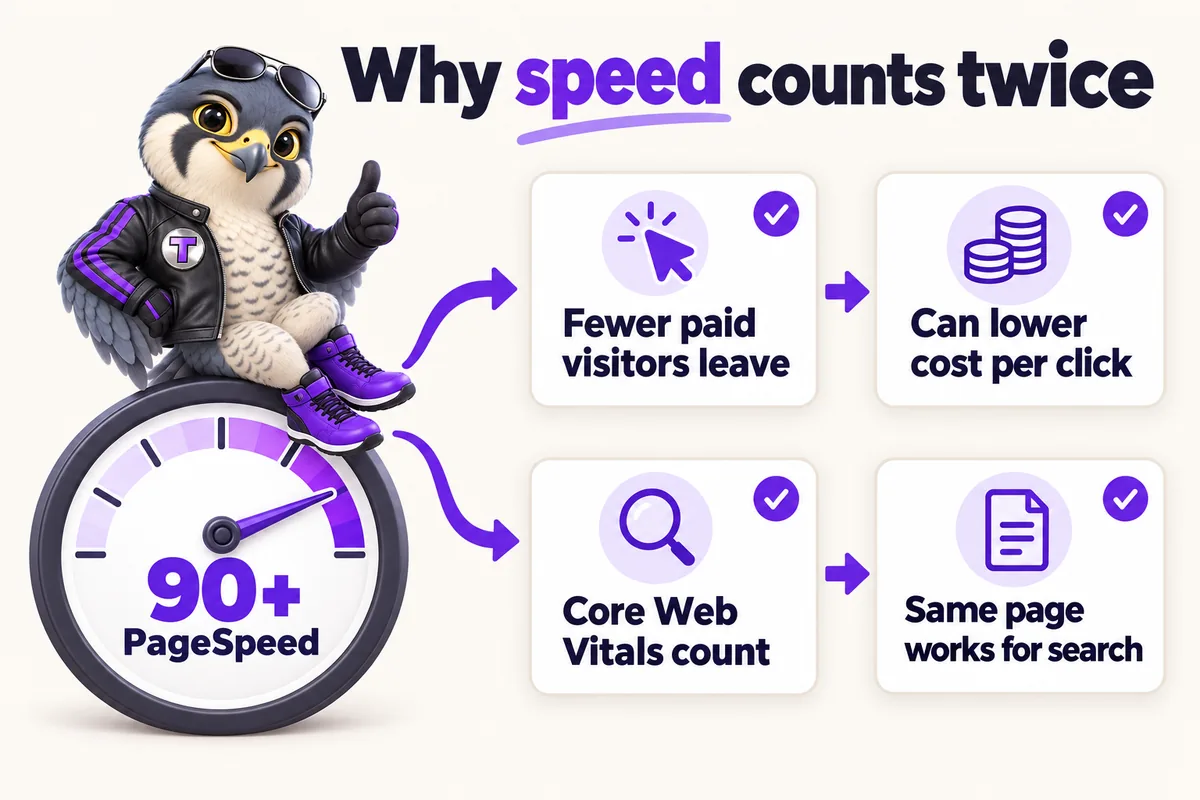
A faster page can lower what you pay for a click, and it keeps more of the visitors you have already paid for. Here is the mechanism, in plain words, with the sources attached.

Infographic with Tarmac, the RentalWebStudio falcon mascot: Why speed counts twice. 90+ PageSpeed. Paid clicks: Fewer paid visitors leave, so it can lower cost per click. Search: Core Web Vitals count, so the same page works for search.
  • You already paid for the click

    A visitor who taps your ad on a phone with two bars of signal and waits for a heavy page is a click you have been charged for and a renter you never met. Speed is not a technical score here, it is how much of what you already spend actually reaches the fleet.

  • What Google actually says

    Google says ad quality and landing page are one of the six factors behind Ad Rank, and that higher quality ads can often lead to lower costs per click. A faster, more relevant landing page can lower what you pay for the same click. It is not a guarantee, and nobody can promise a figure.

  • The same pages have to rank

    Google Search Central states that Core Web Vitals are used by its ranking systems, alongside the rest of page experience. The page a renter lands on from an ad is usually the same page you want ranking without one, so the work counts twice.

  • Photography is the hard part, and it is the point

    A rental page lives on photography, which is exactly what makes most of them slow. Images are compressed and served in modern formats automatically, fonts never block the page, and every page we add follows the same budget as the first, so the 90+ PageSpeed target holds as the fleet grows.

Sources: Google Ads Help, "About Ad Rank", checked September 21, 2026. Google Search Central, "Understanding page experience in Google Search results", checked September 21, 2026. We state the mechanism, never a promised cost per click, position or ranking.

Four ways your fleet gets found, and what each one really means

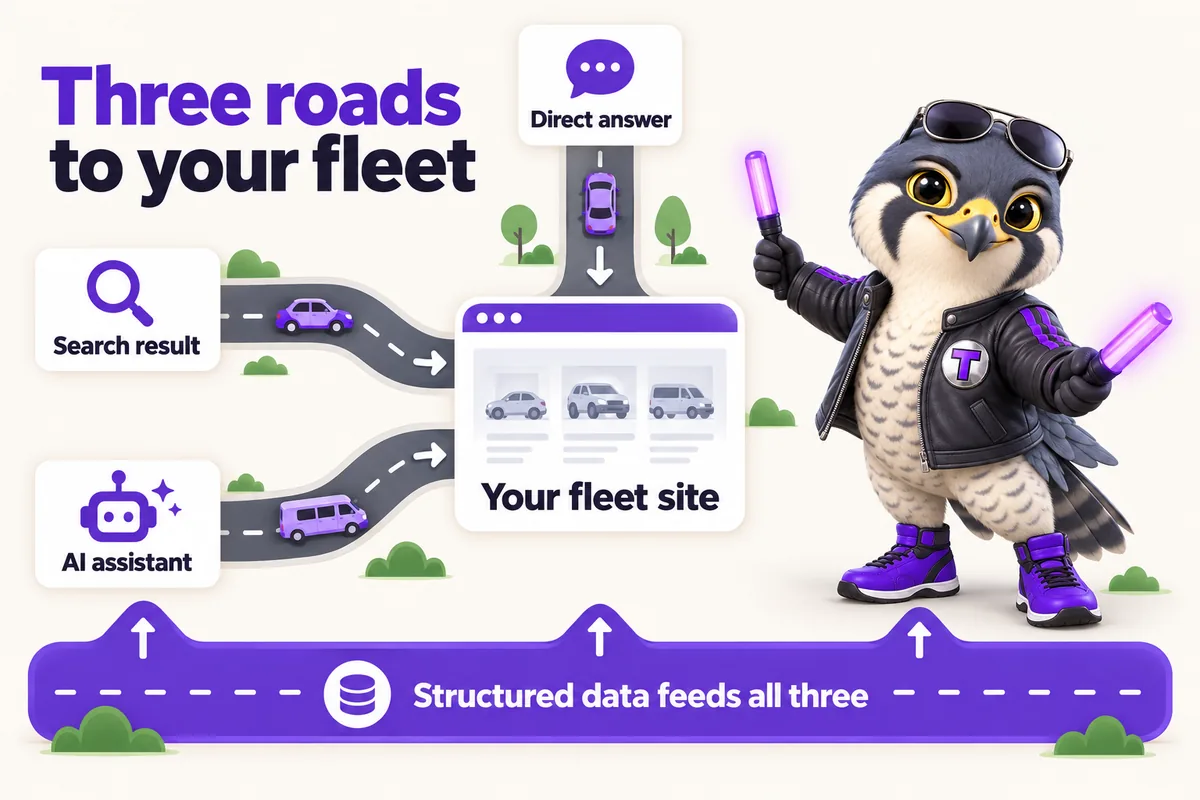
People find a rental fleet three ways now: a search result, a direct answer, or an AI assistant that was asked to plan the trip. All three are part of the build, and so is the structured data that feeds them.

Infographic with Tarmac, the RentalWebStudio falcon mascot: Three roads to your fleet. Search result. Direct answer. AI assistant. All three lead to Your fleet site. Structured data feeds all three.
SEO

Found by people searching for a vehicle near them

Technical and on-page search work is part of the build, not an upsell: clean URLs, one page per vehicle class, titles and descriptions written per page, internal links that actually connect, a sitemap that updates itself, and image files that are named and compressed properly.

  • A service area page for each of your own pickup counters, depots and delivery zones, so a search for a city you serve has a page to land on.
  • Rate and terms pages that answer the question renters search before they book, instead of leaving it for a phone call.
  • 2 to 3 researched articles a week, each 2,500 to 3,200 words, building coverage of the trips and routes your renters ask about.

Search visibility is a slow build. Fleets generally start to see movement in the 3 to 5 months range, and no one can promise a position.

AEO

Found when the answer is given instead of the link

Answer engine optimisation means writing so the answer can be lifted. Every section on your site opens with the direct answer to its own heading, key terms get a short clean definition, and the questions renters actually ask are on the page as questions with full answers.

  • Question shaped headings that match how a renter phrases it, not how the industry phrases it.
  • Visible FAQ blocks on every significant page, marked up so a search engine can read them as questions and answers.
  • Specification blocks and comparison tables that survive being pulled out of the page on their own.

Featured snippets and voice answers are chosen by the engine. We make the content liftable; we do not control whether it gets lifted.

GEO

Found when someone asks an AI assistant instead of a search box

A growing share of trip planning starts in an assistant rather than a search box. Generative engine optimisation is about being quotable and verifiable: stating facts plainly, keeping names consistent, and publishing a machine readable summary of the site that an assistant can read in one request.

  • A live llms.txt and llms-full.txt on your domain, describing the business, the fleet and the key pages in plain text.
  • Consistent entity naming: the same business name, the same class names, the same location names, everywhere on the site.
  • Facts stated with dates and sources, so a claim about your fleet can be checked rather than guessed.

Assistants such as ChatGPT, Claude, Perplexity and Google AI Overviews decide for themselves what to cite. This is how we make it more likely, not a guarantee that it happens.

Schema

Machine readable facts about your business

Structured data is the part of the page written for machines. It tells a search engine what your business is, where it operates, what each page is about and how the pages relate, so the right thing shows up in the right place instead of being inferred from your copy.

  • Organization or LocalBusiness for the business itself, with your locations and contact details.
  • Service markup on each vehicle class and service page, BreadcrumbList on everything below the top level.
  • FAQPage on every page carrying questions, with the markup generated from the visible text so the two can never drift apart.
  • Review markup only once you have real, verifiable reviews. We never generate rating markup from quotes we wrote.

Structured data makes a page eligible for richer results. Google decides whether to show them.

What these features look like in use

Three clients talking about the specific part of the site that changed how their week works.

  • The 'did you receive it?' calls about touring vehicle requests were a daily occurrence here. The acknowledgment explains the next step clearly and tells people how to reach us if something is wrong. It sounds minor until you add up the reassurance calls it has replaced.

    Submission acknowledgment and follow-up for touring vehicle requests

    Olive WellingtonBookings administrator, compact camper hire specialistSavannah, GA
  • People following up on touring vehicle requests used to complete the entire inquiry form again. The two message types arrive under different subjects, so the sorting is done for us. We answer the question now instead of playing archivist first.

    Returning-customer contact path for touring vehicle requests

    Jane GrimsbyDuty manager, winterized motorhome rentalSanta Rosa, CA
  • During the review we asked what happens if the touring vehicle requests form fails. There is now a visible backup route, honest error wording, and a test that proves mail arrives. That attention to the invisible parts of the site gave me confidence in the handover.

    Contact resilience and delivery checks for touring vehicle requests

    Frederick CopperfieldService desk lead, long-term touring van hireReno, NV

What each plan carries

FeatureShowroomConciergeFlagship
Pages that open instantly
A dedicated page for every vehicle class
A reservation request flow that qualifies real trips
A page for every pickup and drop off location
Daily, weekly and monthly rate pages
A gallery built for one vehicle at a time
Researched articles published every week
The AI Engine
The Content Engine
Managed hosting and a domain in your name
A client portal, with changes turned around in days
Moving your current site across, with redirects
Policy pages and consent that actually blocks scripts
Social posts and short videos from the same research

The pages nobody enjoys writing, included with your site

Six of them, written for a vehicle rental business rather than pasted from a generic template, and kept in step with what the site actually does. They help you meet the obligations a public website carries. They are not legal advice, and they do not replace your rental agreement or your insurance.

  • Privacy policy

    Written around what your site actually collects: the reservation request fields, the enquiry form, analytics and any chat widget. It names the data, why you hold it, and how someone asks for a copy or a deletion.

  • Terms and conditions for the website

    The terms for using the site itself: what a reservation request is and is not, that a request is not a confirmed booking, and that your own rental agreement governs the hire. It never replaces your rental contract.

  • Cookie policy with consent that really gates scripts

    The banner is wired so analytics and marketing tags do not fire before consent, rather than a notice that blocks nothing. The policy lists the cookies the site actually sets, and the two stay in step because both are generated from the same configuration.

  • Accessibility statement, and a build to match it

    Semantic markup, keyboard operable navigation, visible focus, contrast checked in both light and dark, respect for reduced motion, and alt text on every photograph of the fleet. The statement names the target and gives a real address for reporting a problem.

  • Disclaimer written for a rental business

    A page that separates what the website says from what your rental agreement, insurance and driver requirements say, so nothing on the site reads as a promise about coverage, licensing or liability.

  • Consent wording on forms that ask for a phone number

    If your reservation flow collects a mobile number for booking updates, the form carries explicit, separate consent wording and a way to opt out, written with US messaging consent rules in mind. You decide what you send; we make sure the form asks properly.

RentalWebStudio is a website design and management company, not a law firm and not a vehicle rental company, broker or fleet operator. We build the pages and the consent mechanics, and we recommend your own attorney reviews them against how your business actually operates before launch. You can see the same page set working on this site: privacy policy, cookie policy, terms, accessibility statement and disclaimer.

How this feature set compares with building it yourself

Nobody buys a website in a vacuum. You are weighing this against the builder you already pay for, the person who made the last one, or leaving things as they are. We have written all ten comparisons honestly, including the cases where the other option is the better choice for a rental business.

See all ten comparisons

How the pieces work together

1

Fleet and locations

Every class and pickup point gets its own page.

2

Reservation flow

Dates, location and class collected before your team replies.

3

Weekly articles

Researched content published on a fixed schedule.

4

AI Engine

Qualifies enquiries around the clock, on tiers 2 and 3.

Questions about what is included

What do the weekly articles actually cover?

Topics your renters are already searching before a trip: what a rental deposit covers, how mileage allowances work, what to check before a long weekend hire, or a guide to a specific vehicle class. You get 2 researched articles a week on Showroom and Concierge, and 3 a week on Flagship, each 2,500 to 3,200 words. Nothing published as advice about insurance, licensing or liability, since that is not what we are.

Do I approve articles before they go live?

You can review the topic list in advance through your client portal and flag anything you would rather we skip. Once a topic is agreed, articles are researched, written and published on schedule without needing a sign off on every draft, which is how the weekly cadence stays on time.

What does the AI Engine actually do for a rental fleet?

It answers real questions about fleet classes, locations and availability, and collects pickup date, return date and vehicle class preference before handing a qualified enquiry to your team. It is trained on your own fleet and rate structure, not a generic script, and it is configured never to quote a rate, confirm a reservation or give insurance or licensing advice.

Does the AI Engine confirm bookings on its own?

No. It qualifies an enquiry and hands it to your team with the trip details already collected. Confirming availability, quoting the final rate and taking payment stay with your team, since those decisions depend on things only your business knows, such as current fleet availability and any deposit terms.

Is the AI Engine included on every plan?

It is included on Concierge and Flagship. Showroom covers the website itself without the AI Engine. You can add it later by moving up a tier from your client portal.

Is hosting an extra cost?

No. Hosting is included in the monthly fee and never billed separately. Your site runs on Cloudflare's global network with SSL, CDN, DDoS protection and unmetered bandwidth included. There is no hosting invoice, no SSL renewal, no bandwidth overage and no surprise line item in month four.

What happens if the site goes down?

Hosting on Cloudflare's network is built for reliability, and we monitor the site as part of managing it. If something needs attention, raise it in your client portal and it is treated the same as any other revision request, completed within 2 to 5 working days.

Do I have to pay for a domain?

No. One domain is included free for as long as your plan is active, registered in your name through Cloudflare Registrar or Spaceship, so you own it outright. If you already have a domain, we point it at the new site instead and nothing changes for renters who know your current address. If you ever leave, tell us where to send the domain and we transfer it at no charge.

Can I keep my current email addresses if you manage the domain?

Yes. Pointing a domain at your new site does not touch your email. We only change the records needed for the website itself, and we confirm the change with you before it happens so nothing about your existing email setup is affected.

I already have a rental website. What happens to it?

Tell us the address in your onboarding form and we review it during the build. Pages worth keeping, such as fleet listings with useful content or articles that already rank, are rebuilt with the same information in the new design. Old URLs that no longer exist are redirected to their closest match, so a link someone already has does not break.
See these features on your own fleet

A live walk-through, in about 30 minutes, built around your vehicle classes.