How many page types you need
Class pages, location pages, rate pages and policy pages are four templates. A fleet needing all four is a larger build than one needing two.
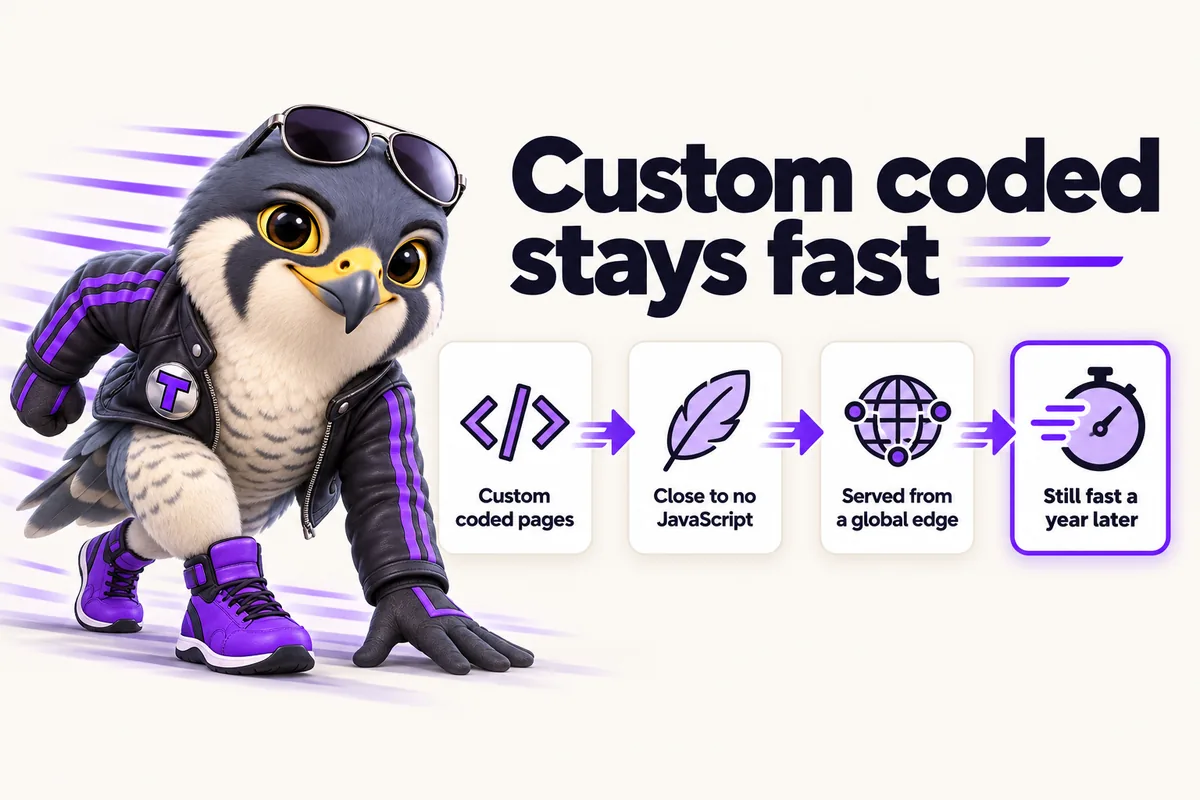
A car rental website is only as fast and reliable as what it is built on, so every page is custom coded rather than assembled from page builder plugins, which is what keeps a fleet site fast on launch day and still fast a year later.
What it costs
Fleet owners who have been told their site is slow, who are adding vehicles faster than the site can carry them, or who are tired of a plugin breaking the enquiry form. This page is about the build itself rather than how it looks.

The monthly fee is the same whatever your fleet looks like. These are the things that decide how much of the first two weeks goes where.
Class pages, location pages, rate pages and policy pages are four templates. A fleet needing all four is a larger build than one needing two.
A tidy site with clean URLs migrates quickly. Hundreds of orphaned pages from an old platform means more redirect mapping.
A direct CRM integration is straightforward. An unusual internal system may need a Zapier or Make step in between.
Image handling is automated, and a fleet with hundreds of images still needs someone deciding which ones go where and in what order.
Fleet sites built on stacked page builder plugins tend to slow down as vehicles are added, since each plugin adds its own scripts and styles. Every page here is written directly, ships close to no JavaScript by default, and is served from a global edge network, so performance does not erode as the fleet grows.
A completed reservation request is delivered into your CRM, inbox or booking system by direct API integration, Zapier or Make, whichever you already use. Nothing depends on a form plugin that could break silently after an update, since there is no third party plugin layer to update.
Every fleet class, location and rate structure is modeled properly in the codebase rather than jammed into generic post types, which is what makes it possible to add a new vehicle class or location as a page rather than a workaround.
The build runs in parallel with the design rather than after it. Onboarding call, fleet and location structure agreed, pages built against the template, migration and redirects mapped from your old site, then launch in seven to fifteen days depending on plan. Every page added afterwards follows the same performance budget as the first.
Live in 7 to 15 days from the onboarding call depending on the plan, then 5 change requests a month completed within 2 to 5 working days.
Every page written directly rather than assembled from plugins.
Reservation requests delivered by API, Zapier or Make.
A page weight and script budget applied to every new page added.
SSL, CDN, DDoS protection and unmetered bandwidth included.
Fleet classes, locations and rates modeled properly, not bolted on.
Four things people reasonably expect and do not get, written here rather than discovered later.
Named reviews from rental businesses we have built for, each about the part of the site that changed.
During the review we asked what happens if the touring vehicle requests form fails. There is now a visible backup route, honest error wording, and a test that proves mail arrives. That attention to the invisible parts of the site gave me confidence in the handover.
Contact resilience and delivery checks for touring vehicle requests
Our old touring vehicle requests routine was a shared inbox and crossed fingers. Ownership is visible now, and cover no longer requires reading someone's entire inbox. It removed a daily friction we had simply learned to live with.
Inquiry assignment and staff handover for touring vehicle requests
The touring vehicle requests form used to punish anyone who missed one answer. The messages name the problem, and correcting a field no longer clears the rest. It now helps people finish instead of catching them out.
Form usability and error handling for touring vehicle requests
Real projects for rental businesses, from the starting point to what changed. Clients are described by type and region, not named.
Stuart SatterfieldFleet administrator, pet-friendly motorhome rental, Savannah, GeorgiaRead the case studyOne message about touring vehicle requests now carries what three used to. The difference shows up every morning.
Nobody buys a website in a vacuum. You are weighing this against the builder you already pay for, the person who made the last one, or leaving things as they are. We have written all ten comparisons honestly, including the cases where the other option is the better choice for a rental business.
We do not name the specific technology stack to clients, since the product you are buying is the finished, managed website rather than a set of tools to maintain yourself. What matters is that every page is custom coded and fast.
Yes, by direct API where one is available, or by Zapier or Make otherwise. Tell us which CRM you use in the onboarding form and we set up the connection as part of the build.
No. There are no page builder plugins to update, and hosting, security and maintenance are handled by us as part of the monthly fee.
Yes, the page and data structure is built to support many vehicle classes and locations without a rebuild, since each new one follows the same underlying model as the first.
Because the two things a rental site must do well, carry heavy photography and stay fast on a phone, pull against each other. Every template platform resolves that by loading more code. A custom build resolves it by shipping almost none, which is why the speed target is possible to hold rather than just to hit once on launch day.
It is a change request. A new template, for example a page type for guided tours or corporate accounts, is bigger than a copy change and still goes through the same process with the same turnaround expectations. Nothing about the site is frozen after launch.
No. Pages are coded, which is what keeps the JavaScript close to zero and the performance budget enforceable. It also means there is no builder for a plugin update to break in eighteen months.
Yes. You review it on a preview address before anything points at your domain, and the build fee is invoiced only after you have approved it and the site is live.
A live walk-through of the site you would get, in about 30 minutes. Plans from $127 a month, the $697 build fee invoiced only after launch, domain and hosting included.
Book a demoOr email and a person replies within one working day.
RentalWebStudio uses the cookies below. Necessary cookies keep the site working and cannot be turned off.
Saved on this device only. Press Esc to close.