How many real locations you have
Every genuine counter, depot or delivery zone is a page with its own local detail. Two is quick; eight takes longer because each one has to be genuinely different.
A rental fleet with an airport counter and a downtown depot is really running two local businesses in search engine terms, so local visibility starts with a dedicated page for each location rather than one location mentioned on a general contact page.
What it costs
Fleets with more than one pickup point, or one pickup point serving several distinct areas. If you have an airport counter and a downtown depot sharing a single contact page, you are running two local businesses from one address.
The monthly fee is the same whatever your fleet looks like. These are the things that decide how much of the first two weeks goes where.
Every genuine counter, depot or delivery zone is a page with its own local detail. Two is quick; eight takes longer because each one has to be genuinely different.
An airport page needs specifics: the terminal, the shuttle, the after hours arrangement. That detail is what makes it rank and it has to come from you.
A delivery zone is a service area rather than an address, and it needs its own explanation of terms and any charges.
Different hours, seasonal opening and after hours collection all need stating per page rather than globally.
Each pickup or drop off location gets its own page with its own address, hours, directions and the vehicle classes available from that counter. This is what lets a search for a pickup near a specific airport or neighborhood find the exact page for it, rather than a home page trying to represent every location at once.
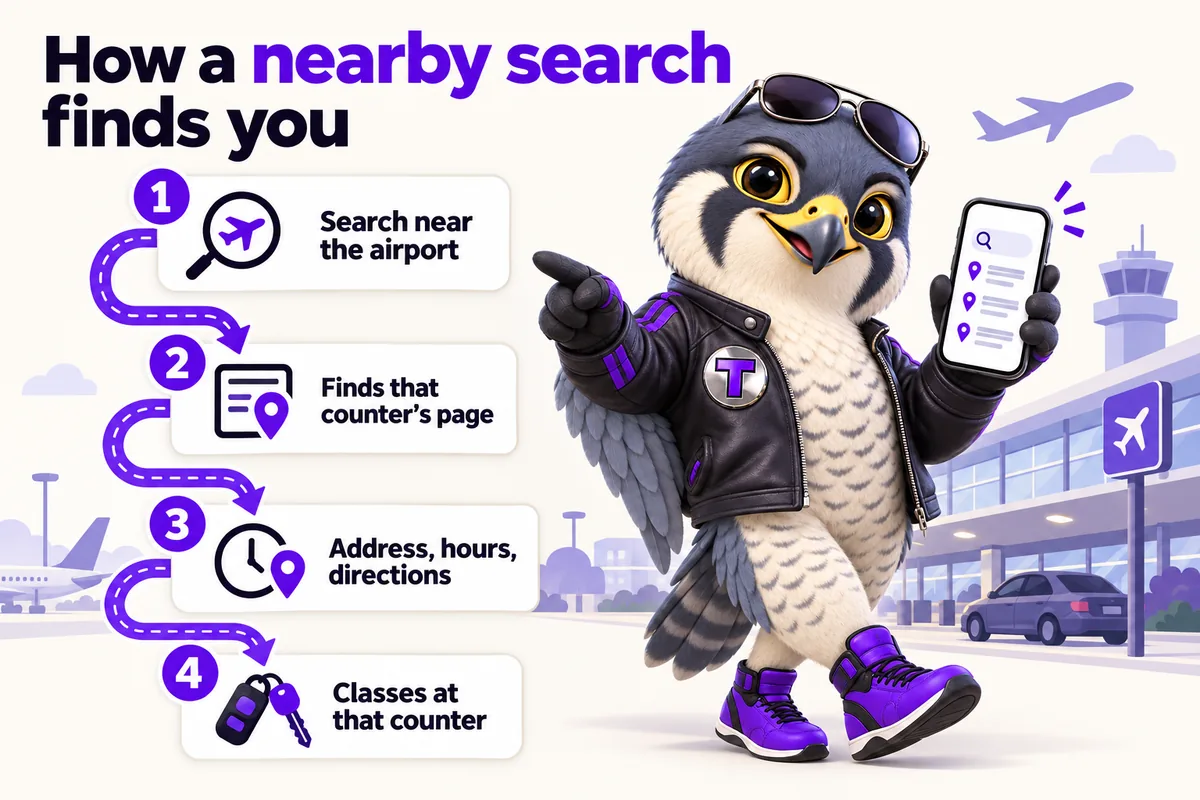
If the fleet delivers to a resort area or supports one way drop off in another city, that zone gets a page describing the terms and vehicle classes available for it. This mirrors the page architecture a national brand uses across its entire market, sized appropriately for a fleet with a handful of locations.
Address, phone and hours are kept consistent across every location page and any business directory listing you maintain, since inconsistent details are one of the more common reasons a location fails to show up reliably in local search results.
Location pages are built with the rest of the site, using the addresses, hours and available classes you supply on the onboarding call. A new counter or delivery zone added later is a change request, turned around in two to five working days, so opening a location does not wait on a website project.
Live in 7 to 15 days from the onboarding call depending on the plan, then 5 change requests a month completed within 2 to 5 working days.
Address, hours, directions and available classes per pickup point.
A page for each delivery area or one way route you support.
Address, phone and hours kept aligned across the site.
Location details marked up so search engines can read them cleanly.
Articles that reference real service areas where relevant.
Four things people reasonably expect and do not get, written here rather than discovered later.
Named reviews from rental businesses we have built for, each about the part of the site that changed.
Misdirected touring vehicle requests calls were a daily tax before this. Each service description carries its own local contact, and the form inherits it. Simpler for visitors, and much simpler for whoever covers the phone.
Location information and contact routing for touring vehicle requests
The after-hours side of touring vehicle requests was an afterthought on the old site. The form captures what a callback needs and says clearly that a person replies in working hours. Nobody mistakes an automated acknowledgment for an answer, which matters to us.
After-hours inquiry capture for touring vehicle requests
The reporting for touring vehicle requests is something I can genuinely use. Each inquiry records where it began, which is the only number I asked for. It establishes honest measurement without pretending to prove results.
Basic inquiry source reporting for touring vehicle requests
Real projects for rental businesses, from the starting point to what changed. Clients are described by type and region, not named.
Madhuri NarayanDepot coordinator, surf trip campervan hire, Sioux Falls, South DakotaRead the case studyI can open the touring vehicle requests queue and see who owns what. That was impossible to say six months ago.
Nobody buys a website in a vacuum. You are weighing this against the builder you already pay for, the person who made the last one, or leaving things as they are. We have written all ten comparisons honestly, including the cases where the other option is the better choice for a rental business.
As many as your fleet actually operates from. Each new location follows the same page pattern, so adding a fourth or fifth counter does not require rebuilding the site.
The site is built to keep your details consistent, and we can advise on directory listings during onboarding, but ongoing directory management outside the website itself is not part of the standard plan.
Yes, each location page shows only the classes actually available from that counter, which keeps the information accurate rather than listing the full fleet everywhere.
Yes, a delivery zone page works the same way, describing the areas you deliver to and the terms that apply, even without a walk in counter.
One per place you genuinely operate from or deliver to, and not one more. Pages for cities you do not serve are the fastest way to damage a domain, and they are obvious to both search engines and renters.
Specific local detail that could not be copied to another city: the terminal and the shuttle, the neighbourhood, the parking situation, which classes are actually at that counter, the after hours arrangement. A page with the city name swapped in is worse than no page.
Yes, framed honestly as a delivery area rather than a location, with your terms and any charges for it. That is a real service and a real page. Pretending there is a counter there is not.
Managing profiles is not part of this offer, and we will make sure the information on your site matches what a profile should say, consistently across every location page, which is the part that goes wrong most often.
A live walk-through of the site you would get, in about 30 minutes. Plans from $127 a month, the $697 build fee invoiced only after launch, domain and hosting included.
Book a demoOr email and a person replies within one working day.
RentalWebStudio uses the cookies below. Necessary cookies keep the site working and cannot be turned off.
Saved on this device only. Press Esc to close.